How to Choose Between Native vs Cross-Platform App Development

Introduction
In the modern context, mobile apps are not an option for any business around the world. If you want to engage your customers, streamline operations, and stay above the competition, then your Australian business needs to understand how much a mobile app matters to its business activities.
From all corners of Australia, every company, from startups to enterprises, is rallying up to invest in app development. – and for what? Better user experience, operational efficiency, and overall revenue. Yet, there’s that common confusion between whether to go for native and cross-platform app development.
Native apps, just like their name, are built for one single operating system – either iOS or Android. But cross-platform apps are a combination of both and can be put together using frameworks such as Flutter or React Native – like its name, cross-platform apps are built to function on multiple platforms using one codebase.
Do we pick one? We’ll get there. But first, we need to note that both of these approaches have their own pros, cons, and costs. So how do you know which works for you? That all depends on your business goals, target audience, budget, and long-term growth plans.
However, you need to remember that no matter what method you go for, your app needs to be tip-top and fast, real fast. Australian users have high standards when it comes to app performance, speed, and reliability. Don’t believe us? Well, we’re sorry to say that the chances of a Aussie consumer dropping a slow, crashing app with poor usability are high. At the end of that spectrum, you have SMEs and startups that are struggling to balance the cost and speed of deployment, and here’s where cross-platform becomes your best friend.
If you’re still confused about making a choice, don’t worry, we didn’t expect you to get it all yet, so keep reading this guide, and you might find an answer. We’re talking about everything from understanding the differences, benefits, and considerations between native and cross-platform development. We’ll take you through the app development costs, performance, scalability, frameworks, and decision-making strategies, with real-world scenarios from Australia that will help you understand the context of things better.
And when it’s all over, you’ll have a clear roadmap that will help you select the approach that works for your business – and how Digital8 can partner with you for an app that is ready to take over the future!

Understanding Native App Development
So what is native app development?
We’ll start slow and break it down: native app development simply means to build an app for one platform (either iOS or Android). Native apps are so specific to their own platform that they come with platform-specific languages such as Swift for iOS and Kotlin for Android. The native app approach comes with high performance, smooth animations, and complete access to device hardware such as cameras, GPS, and sensors.
A native app’s trump card is its ability to deliver an optimal user experience, especially for heavy functionalities and graphics-heavy apps. If you put it into a real-world context, an Australian-based retail app built natively can easily handle AR product visualisation and seamless payment processing, giving you an elite user experience over hybrid alternatives.
But these great benefits of native apps come with pricey development costs and longer time frames – the main reason is that each platform requires an individual codebase of its own. And if developmental costs are pricey, that means your maintenance process and costing are also not far behind. The maintenance process comes with complex updates that must be inserted individually for iOS and Android. Regardless of the lengthy, effortful process, native apps still stand as an ideal solution for apps that are looking for high security, advanced features, or intensive device integration.
Generally, Australian businesses that do go for native apps are businesses from fintech, healthcare, or gaming, and it’s mainly because they want to meet user requirements/expectations and regulatory standards, in compliance with the laws under the Privacy Act 1988.
Key Factors to Consider When Choosing
Before choosing whether to go for native or cross-platform app development, you need to think over some critical factors.
We’ll start with the first and maybe the most important one: performance. Some of the main features that give native apps the spotlight are their quick load times, smooth animations, and full access to device hardware. Cross-platforms are indeed gaining traction with time; however, there are certain hitches when it comes to high-performance features such as AR, VR, or graphics-heavy apps.
Moving on to our next factor: user experience (UX).
Native apps usually come with a more responsive, seamless, and customised experience to each platform’s design standards. Cross-platform apps have to maintain consistency across multiple devices, but may need extra design adjustments that suit the local expectations. But one of the critical factors behind perfecting user experience lies in knowing your target user’s preferences and device usage – and this is a must for Australian businesses.
Budget and timelines also play a huge role in deciding which platform to go for. Since native apps need separate development processes for iOS and Android, this means high costs and time. Cross-platforms work with just one codebase, and that means it incurs low development time and expenses.
And finally, we’ve got maintenance, scalability, and regulatory compliance to think about.
Any app an Australian business decides to create must adhere to the privacy laws under the Privacy Act 1988, and be able to grow along with the company, additional features, and for regional expansion.
These are the factors you need to know before selecting either native or cross-platform development for your business. Once you evaluate each factor (performance, UX, budget, and compliance), your Australian business can make a choice that works in both the short and long term.
Cost Comparison: Native vs Cross-Platform Apps
You cannot get into native or cross-platform app development without understanding costs, so let us make it easier for you.
One of the main cost factors that divides native and cross-platform is its nature of the codebase. Add to that development, testing, and maintenance costs, and there you have pretty much everything that covers costing.
Usually, the development costs for a single native app start at AUD 25,000 up to AUD 50,000 per platform; however, maintenance and platform updates will add to costs.
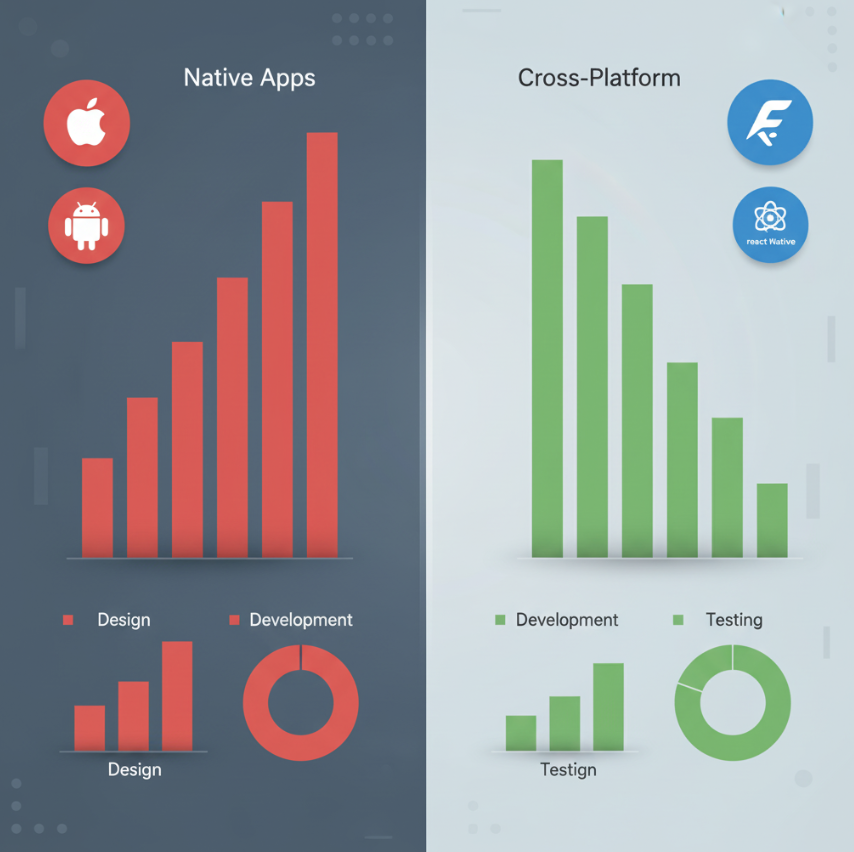
With cross-platform apps using a single code base for multiple platforms, this lowers development costs as well as the time. And with that, it’s safe to say that a lot of Australian-based startups and SMEs tend to go for this approach due to faster launches and optimised budgets, with costs usually being 30-50% lower than native alternatives.
It is also known that cross-platforms make it a lot easier to update and add new features, which makes it popular demand, due to its low ongoing maintenance expenses.
Though the low-cost nature of cross-platform apps makes it more attractive for the industry, businesses must not forget to check in on possible performance trade-offs. If your business is planning to have an app with complex additions, high-speed processing, or intensive device integration, then native apps might be the better option in terms of ROI in the long run. Other important factors, such as project scope, budget, performance needs, and long-term goals, matter for Australian businesses in order to make the best investment option.
Performance & User Experience Considerations
Performance and user experience (UX) play a significant role in your app’s success. The average Australian user is looking for an app that loads quickly, responds smoothly, and delivers natural navigation, no matter what device or platform they are on.
Being optimised for a specific operating system, native apps take first place in performance due to faster load times, smooth animations, and direct access to device hardware, including cameras, GPS, and sensors.
While cross-platform apps have come a long way, they still have some improvements to work on, from minor delays to heavy graphics or resource-intensive operations. However, near-native performance can be achieved with frameworks such as Flutter and React Native, which makes them good contenders for business applications – especially if you’re a Australian SME looking for a cost-effective, multi-platform solution.
UX and performance run hand in hand, so UX is just as important as performance. The easier on the eyes your UX is, the better, and this is because your app needs to be able to offer clear navigation, interactive feedback, and responsive layouts. Native apps stick to platform-specific guidelines, which work to better user familiarity and satisfaction. When it comes to cross-platform apps, it requires special additional design adjustments in order to maintain consistency across multiple devices – this is all to ensure users get a smooth, predictable experience.
Looking for ways to increase engagement for your app? UX elements are the way to go, and with a few such as smart notifications, personalised content, and offline functionality, you can achieve this. Top that with performance optimisation that has a user-centric design, and Australian businesses can easily reduce churn rate, retain users, and enhance conversion rates.
Want to achieve that perfect balance between performance and UX? Here at Digital8, our development teams will guarantee that your Aussie business app will meet local user expectations and global standards.
Scalability & Future-Proofing Your App
Prepping your app to be scalable and future-ready is more important than ever in 2026. An app that grows lasts for a long time. With the growing demands of the current market and consumer, Australian businesses are looking for apps that can grow with users’ demands, are able to adapt to new features and new technologies such as AI, IoT, and augmented reality. As native apps come with high-performing systems, it makes it easier for resource-intensive features to scale up. When it comes to cross-platform apps, modular architectures allow developers to add functionalities in a way that doesn’t require developers to rewrite a completely new codebase.
Cloud integration plays a huge role when it comes to scalability. With the help of backends, apps can handle high traffic and increasing data storage demands without any hitches. For any promising Australian SME, scalable apps allow expansion into new regions, seamless user onboarding, and support for future integrations, minus downtime or redevelopment costs.
Readying your app for the future also comes with maintaining compliance with Australian privacy laws, sticking to and following up with updating app security, and ensuring compatibility with new operating system releases. Regular performance check-ins and repetitive updates are a must in order to prevent app stagnation.
Digital8 ensures your business app is ready for the future by seamlessly combining scalable architecture, strategic planning and emerging technologies.
This way, your apps stay relevant, high-performing, and competitive in Australia’s evolving market. When you have an app that’s ready to meet future changes, you can easily focus on your business growth, and your app will be right behind you.
Popular Frameworks for Native & Cross-Platform Apps
The right app framework determines whether your app is a high-performing, scalable, or user-friendly app. Native apps usually use Swift for iOS platforms and Kotlin for Android. Some of the leading traits that make Swift a popular choice are its speed and performance, smooth animations, and in-depth integration with Apple’s ecosystem, which makes it perfect for both iPhone and iPad users. Kotlin’s strengths lie in its compatibility, security, and modern language features.
Through cross-platform businesses can reach out to users on both iOS and Android platforms, which is built under a single codebase. Under the ownership of Google, we have Flutter, which offers a range of widgets, near-native performance, and a fast development process.
Released under Meta, React Native gets its fame for its reusable features, heavy community support, and flexibility.
For Xamarin, you can integrate it with Microsoft tech and provide access to native APIs, which is ideal for enterprise-level businesses.
The reason why many Australian SMEs and startups go for cross-platform frameworks is due to their low costs, speedy deployment process, and the ability to have a user experience on both iOS and Android. Now, if your business app requires tight security, device-specific features, or graphic-heavy operations, then a native framework is your best option.
Here at Digital8, we help businesses understand each framework and help select ones that work best for business goals, budget, and target audience, which guarantees that your app will stand out in the future, customised for local user expectations.

Making the Right Decision for Your Business
Once again, the right platform is decided based on your business goals, target audience, budget, and long-term growth goals.
If your business hails from industries such as fintech, healthcare, or gaming, then a native app can offer the app some solid abilities such as advanced device integration, a lux user experience, and endurance for high performance.
However, if your business is budget-conscious, expecting a rapid deployment or looking for a multi-platform approach, then cross-platform is the option.
It’s important to consider regional factors. If you’re an Australian-based SME, you can reach your local users with a cross-platform app. Benefits? Lower costs and a steady UX across many devices. However, if your business is an enterprise, your requirements may differ – you may require additional security measures and challenging workflows, which sounds like a native approach.
So how do we make this easier? A decision matrix will do it. Evaluating factors such as cost, maintenance, timeline, scalability, and regulatory compliance helps you understand which works better for specific factors. There are times when a hybrid strategy might be more sensible by grounding your app’s core features natively and using cross-platform for supplementary modules.
With the help of our teams at Digital8, we help businesses balance cost, functionality, and user experience when making the right choice of framework for their app.
The key formula for an efficient, user-friendly, and scalable app is to combine your app’s development strategy with your business objectives. This approach will ensure that your app has an unbreakable foundation in today’s competitive Australian market.
How Digital8 Helps Australian Businesses Decide & Build Apps
Our teams at Digital8 will guide your business on figuring out the complex decision between native and cross-platform development. We work closely with our clients to ensure that their business objectives, target audience, budget, and timeline are considered and are aligned with the development approach.
We’ll take a look at your business size and decide which option would work best. If it’s an SME or startup, our teams will look at cross-platform frameworks such as Flutter or React Native as an option that has quick deployment and is cost-efficient (zero compromises on UX!). If you’re an enterprise looking for apps with high-performance features, then a native app can promise you good security, speed, and smooth device integration.
Our teams do not play about when it comes to protecting consumer data in our app development work. We at Digital8 are well-versed with Australia’s privacy and data protection regulations under the Privacy Act 1988. Trust us to deliver you an app with end-to-end app development services that cover stellar UX/UI designs, architecture planning that lasts, backend integrations, performance optimisation, and post-launch assistance.
With Digital8, you will know each step of your app development journey. We include solid strategies, approaches to shield your app for the future, scalable solutions and information-rich guidance at each level. Once your app is completed, you’ll have a final product that is not just ready to take on your current customers, but is also ready to grow and explore new technologies in the future.
Real Australian Case Studies: Native vs Cross-platform Apps
Atlassian (Sydney) – Cross-Platform at Scale
Sydney-based software company, Atlassian, made use of React Native to create a mobile experience for both iOS and Android, with a single code-based design system. As per Atlassian’s engineering team, the reason they decided to move to React Native using an in-house tool (DevMate) was to lower build times, better developer efficiency, and streamline cross-platform workflows.
This case is a good example of how enterprise-level Aussie businesses that usually require high-performance needs can easily go for cross-platform approaches, given that architecture, testing and performance optimisation are managed orderly. If your business is considering between native and cross-platform, Atlassian’s case reveals how cross-platform can still bring its A game for larger playing fields.

Key Takeaways for Australian Businesses
- Cross-platform frameworks such as React Native and Flutter tend to be more cost-effective and efficient options if your business app is looking for a wider reach, especially in SMEs or regional apps.
- Native apps are the choice for apps with premium, high-end requirements, such as heavy performance, premium UX, device integration, and secure regulatory policies.
- Your choice of app framework will always come down to the nature of your business – know your target audience, regional reach (metro or regional Australia), budget constraints, performance needs, and scalability goals – then you’ll soon discover the right app framework that ticks all the boxes.
Conclusion
Determining which app framework is best for your business is a crucial decision for Australian companies. Your business app is a digital face for your business, so you need to be confident with your pick. By now, you may have e clear idea of the high-performance nature, advanced device integration, and premium user experience of native apps, and the more cost-efficient, fast deployment, and consistent experiences via multiple devices. At the end, it all comes down to your business goals, target audience, budget, and long-term growth plans.
Every Australian business that either has an app or is planning to go for one will always be more confident about their app’s standing with a better understanding of app performance, UX, scalability, maintenance, and regulatory compliance. For startups and businesses running on tight budgets, cross-platform networks such as Flutter and React Native are ideal options, as they only minimal requirements over native apps, which most high-level enterprises go for due to their heavy functionalities, high security, or graphics-intensive features.
So how does Digital8 tie into this? We help your business make the above decision, with knowledge and confidence. Our app development teams will create an app for you that can easily adapt to the future, is scalable, and custom-built for the local market. With qualified expertise in UX/UI design, cloud integration, AI personalisation, and Australian privacy compliance, we bring strategies and solutions that speak to your users’ needs and business goals.
If you read this blog and are considering App Development, We are leading App Development agency in Brisbane and our Team are just a phone call away!
Let’s make your business stay ahead of the digital curve with a high-performing app that is ready to take on the future. How? Simply talk to us at Digital8 today or schedule a consultation, and we’ll make an app backed by proper experience and guidance.
Are you ready to grow your business?
We write about a variety of topics in the digital industry.