How Australian Businesses Can Prepare Their Website for AI Search Results

The meaning of search is changing, and Australian businesses need to catch up, fast.
This change is about going from traditional Google rankings to ranking on AI tools, so if your business is still spending bucks on optimising just for Google, you’re a tad behind. The search engine of 2026 isn’t determined by the generation of links, but direct answers.
Nowadays, the average user has become too occupied to prioritise links on search engines over direct answers to a problem they’re trying to solve – and tools like ChatGPT, Perplexity AI, and others are doing this for them, allowing users to get instant answers without scrolling through multiple websites.
And as a business, that means it’s not just about ranking, but about being chosen and cited.
New to AI Search? Keep reading this guide, and we’ll show you how your business website can stay visible in this AI-driven search landscape of 2026.
 The Shift from SEO to AI Search (GEO & AEO Explained)
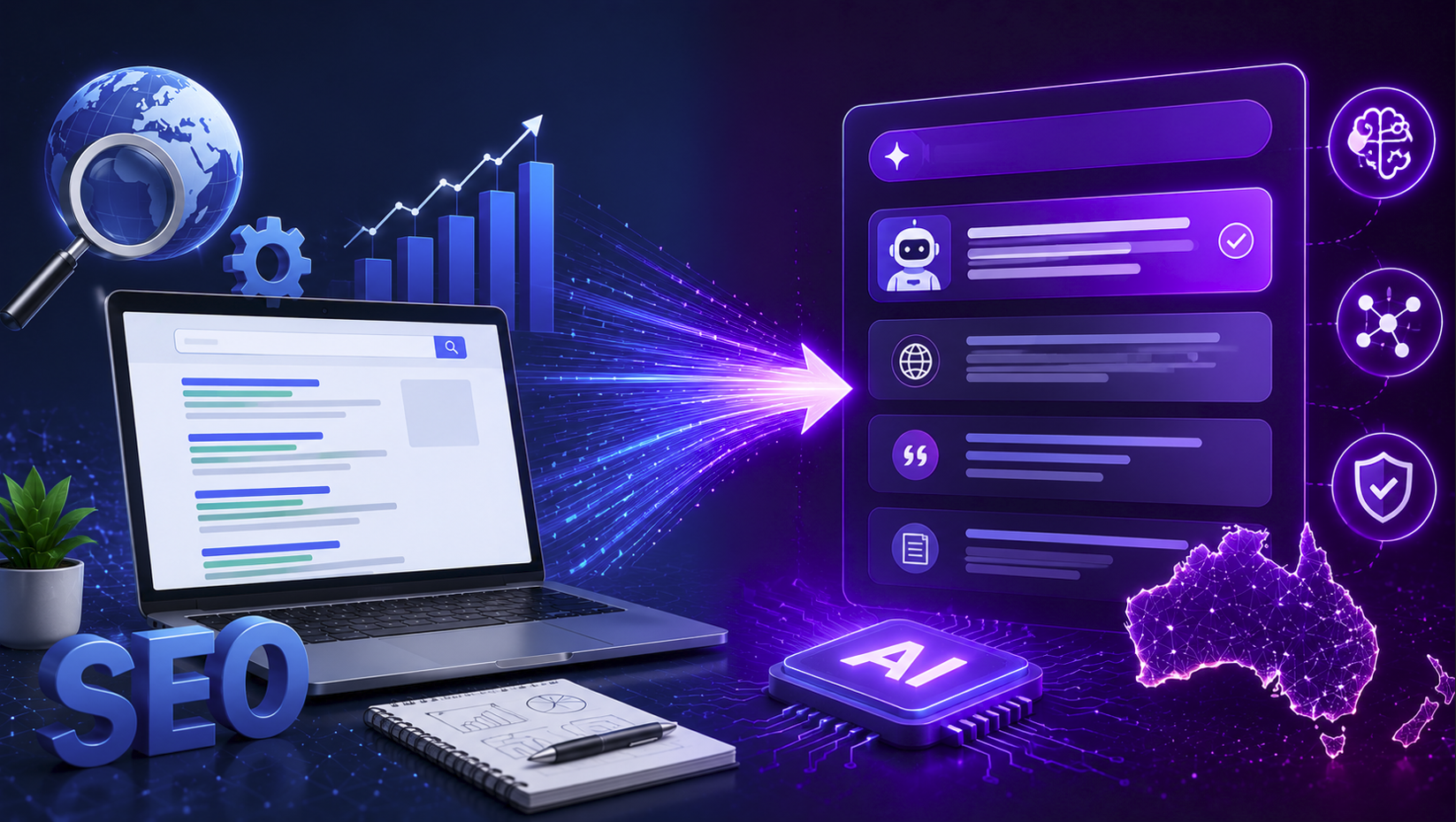
We know the traditional SEO rodeo, which is a repeat of keywords, backlinks, and technical performance. And while all that is still relevant, AI search is setting a new standard that cannot be ignored.
Here’s how it looks today:
- Generative Engine Optimisation (GEO): This is where you optimise content to show up in AI-generated answers.
- Answer Engine Optimisation (AEO): Optimising content to directly answer user queries.
So instead of:
“Here are 10 links – go find your answer.”
Users now get:
“Here’s your answer – summarised just the way you like.”
This shift is going from the “search economy” to an “answer economy”, where your site’s visibility is based on how well your content can be picked up by AI systems, and not just how well it ranks on search results.
How AI Search Engines Rank Content in 2026
Understanding how AI search engines rank content is the first step to getting noticed by AI search engines. Over traditional search engines, AI search engines select content based on their level of trustworthiness, ease of extractability and how useful they are to a user’s query.
Here are the key factors shaping AI visibility in 2026 that you need to know:
Entity Authority & Trust Signals
AI systems know when a brand is trustworthy and recognisable, and they prefer those specific brands.
To get AI systems to trust in your brand, you must establish authority through:
- Consistent brand mentions throughout the web
- The use of forums, reviews and other third-party references
- Strong author credibility
While backlinks were and still are important, they’re not enough anymore. It goes a bit more than that when AI models are now trained to detect and break down deeper signals to know if your content is worth a citation.
Content Clarity & Structure
AI reads content differently from humans. It takes a piece of content and breaks it down into parts, understands, and then extracts.
Which is why your content needs to be organised and include:
- Clear headings (H1-H3)
- Short, direct paragraphs
- Bullet points and structured lists
The messier and more disorganised your content is, the harder it is for AI to read.
Freshness & Relevance
With time, AI models have shown to consider:
- Newly updated content
- Accurate and relevant information
- Clear timestamps
Frequent updates are key, so if your page has not been through a recent update its unlikely to show up in AI-generated answers.
7 Key Strategies to Optimise for AI Search
This is where we get practical. Below are some of the core actions your business should take in 2026:
Write for Questions, Not JUST Keywords
Most of the AI models for AI search are trained on conversational queries. Once you learn this, you know what to feed AI.
So instead of targeting:
Go for:
- “How do I optimise my website for AI search results?”
When writing content for your page, use:
- FAQ sections
- Question-based subheadings
- Natural language phrasing
This will put your content in the view path of AI tools.
Structure Content for Easy Extraction
As mentioned earlier, AI tools break your content down and then extract. To make it easier, imagine AI lifting and reusing your content.
To make this process smoother for AI tools, the best practices your business can follow are:
- Using clear definitions
- Breaking steps into lists
- Avoiding long, dense paragraphs
Example:
What to do:
Step 1: audit your content
Step 2: add structured data
What not to do:
Add lengthy blocks of text with zero hierarchy
If your content is easy to extract, then it is more likely to be used by AI.
Implement Schema Markup
AI search thrives on structured and organised content, as this helps it to get a good grasp of your content.
For a more structured approach on your page, focus on:
- FAQ schema
- Article schema
- Organisation schema
This technical bit is a necessity to help AI systems understand and break down your content accurately.
Build Topical Authority (Not Just Pages)
Topical authority in pages has become a key consideration of AI models, which means they will prioritise websites with depth and structured informative content over singular articles.
For this, when creating blogs, go for:
- Topic clusters
- Interlinked content
- Pillar pages with supporting articles
Example:
A complete guide on AI search optimisation
Supporting blogs on GEO, schema, AI rankings, etc.
Rich, informative content tells AI search engines that you know what you’re selling, which increases your chances of being cited.
Optimise for “Citation Worthiness”
Unlike in traditional search engines, where ranking is the deal, in AI search, you know you’ve made it if you’re mentioned. This is called being “cited”.
To be cited, you must:
- Include original insights
- Use data and statistics
- Add expert commentary
The key is to stand out from a sea of generic content by making your content valuable enough for AI to notice.
Strengthen Your Brand Entity
AI systems need to know who is offering them information, and they will evaluate this to a T.
So make sure your website is clear about:
- Who you are
- You are of specialisation
- Why you’re credible
The above can be done through:
- Informative About pages
- Author bios
- Consistent branding across platforms
Maintain Strong Technical SEO Foundations
AI search doesn’t change everything you did before for SEO, so don’t loosen priority on your technical SEO. If anything, AI search is built on technical SEO.
Make sure your site includes:
- Quick loading speeds (no more than 2 seconds)
- Mobile optimisation
- Clean, crawlable structure
The simple rule is that if search engines are finding it difficult to get to your content, so are AI systems.
 How AI Search Impacts Website Traffic
Every online business out there is here for the traffic. You’re probably wondering how this works when AI search is increasing zero-click results in the new “answer economy”.
Here’s where the change happens:
- Less traffic
- Higher intent
Users who do end up clicking are usually:
- More informed
- Close to converting
This is a direct sign to shift your focus from:
Traffic volume → Traffic quality
Why Australian Businesses Need to Act Now
AI search has been making waves since 2024, and by now, it’s fully transformed the ecosystem of search results.
And for your Australian business, it’s a unique opportunity since:
- Competitors haven’t adapted yet
- Early adopters can dominate AI citations
- Local authority signals can be leveraged
In a digital space where visibility compounds over time, your business will be catching up if you wait too long, so the time to hop on AI search is not tomorrow but right now.
The Future of Search: From Ranking to Being the Answer
Here’s where everything truly changes: It’s knowing that search is not about being the best result on a search results page. It’s about being the right answer your user is looking for.
So success in the search for 2026 looks something like this:
- Being mentioned in AI-generated responses
- Appearing in summaries and not just rankings
- Building authority over time across several platforms
This process is called moving from.”
Share of voice → Share of model
Final Thoughts
AI search might sound a tad intimidating, but it isn’t here to completely takeover SEO. It’s simply tweaking the game.
And for those running Australian businesses, it means that to adapt early is to shape how their websites are shown in AI results, and to not adapt is to risk becoming hidden by all the competition.
One of the key takeaways from this guide is that your business is not here to rank only on Google anymore, but to be chosen, seen, and cited by AI.
And to level the playing field with AI, you need to be smarter and more structured with your content now more than ever.
If you read this blog and are considering App Development, We are leading Web Development agency in Brisbane and our Team are just a phone call away!
Let’s make your business stay ahead of the digital curve with a high-performing app that is ready to take on the future. How? Simply talk to us at Digital8 today or schedule a consultation, and we’ll make an app backed by proper experience and guidance.
Learn More: Web Development Trends
Are you ready to grow your business?
We write about a variety of topics in the digital industry.