How to Design an App for Maximum User Engagement & Retention

Introduction
In today’s digital context, the cost of releasing a half-arsed app that fails to retain and engage users is too costly.
So, no matter where you run your business, whether in Brisbane, Sydney or Melbourne, knowing the core fundamentals of user engagement and retention is essential for your app to survive in the long run. Because a high user churn rate won’t just bring down your ROI but also damage your brand reputation and customer loyalty.
When designing an app for engagement, it’s not the coding that comes first, but understanding everything about your audience, mapping their journey and building an experience that feels intuitive, personalised, and rewarding.
What does this mean for Australian users?
It means Aussie users are betting on so much when it comes to their app, such as cultural factors, local preferences, and technical factors, such as mobile data speeds in rural areas.
From UX/UI design to onboarding processes, notifications, performance, and ongoing updates- engagement and retention are impacted by each aspect of your app. And it is proven that apps that tend to prioritise clarity, speed, and relevance have recorded high retention rates, improved user satisfaction, and high lifetime value.
In this blog, we’ll share everything you need to know about designing an app that not only looks great but also delivers engagement and retention that sticks around on both iOS and Android, all with the aid of research-backed strategies, practical UX/UI tips, and actionable design principles.
 Understanding User Engagement & Retention
Let’s first figure out what exactly engagement and retention are, and why these two are determining factors for your business app’s success.
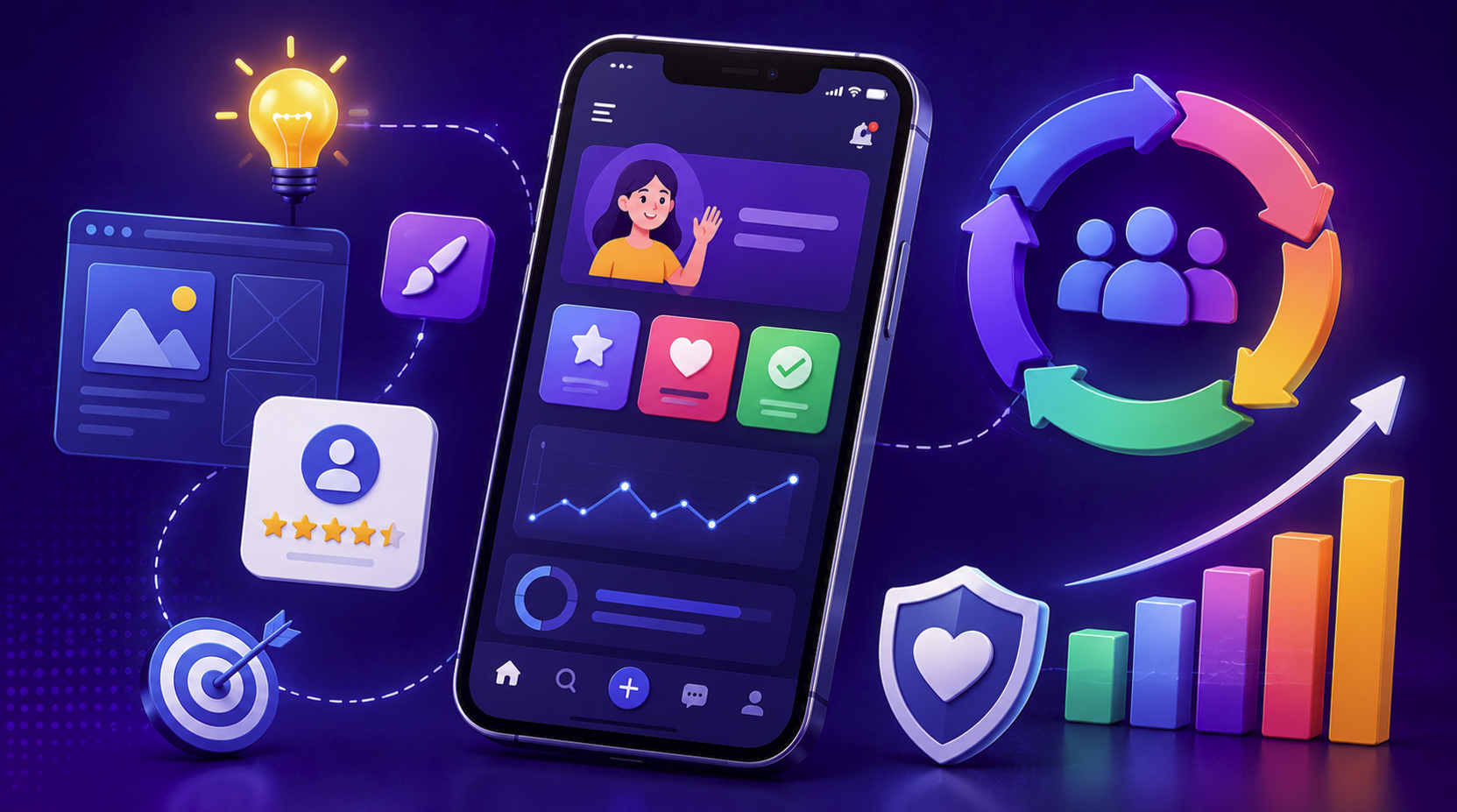
Engagement is what you call when your users directly interact with your app. This can be in the form of clicking buttons, surfing through content, fulfilling tasks or using features continuously. Now, retention means the measure of how long it takes for users to return to the app after they make the first download. This focuses on long-term satisfaction and value.
If you are a business in Brisbane, Sydney, or Melbourne, then you need to know the ins and outs of engagement and retention.
An app with bad design can bring you a lot of downfall, from high churn rates to wasted development costs, and missed revenue opportunities. Now, apps that do win engagement end up with a loyal customer base, solid reviews, and organic growth, which do well in this competitive market.
Some of the key factors that really impact your engagement are intuitive navigation, quick performance, and personalised experiences. And some factors that will really boost your retention are effective onboarding, rewards, smooth updates, and meaningful push notifications. Let’s not forget analytics. Analytics are important when it comes to keeping track of metrics such as monthly active users (MAU), daily active users (DAU), session length, and churn rate. If you want to enhance your customer satisfaction levels, gain impressive ROI, and make sure your app stays consistent and relevant in this mobile-first marketplace, you need to put engagement and retention first.
Grasping these key fundamentals is the first step in designing an app that users not only find functional, but also can’t help but return to.
Conducting Research: Know Your Australian Audience
An app design with purpose has one main factor realised, and that’s a thorough understanding of your target audience. And for Aussie businesses, this means looking past the generic and obtaining insights that are appropriate for Brisbane, Sydney, Melbourne, or other regional markets. There has never been a bad side to conducting more research, and more research means your designers are able to bring life to experiences that users can truly relate to, increasing engagement and retention levels in the long run.
You start your research by getting to know your audience, and there’s no better method than with user personas. These are detailed customer profiles which include your audience demographics, behavioural patterns, pain points, and preferences. For instance, a Brisbane-based food delivery app can go for younger professionals or students who prioritise speed and convenience when it comes to their food orders, and on the other hand, a fintech company in Sydney can target tech-savvy users who look for stronger security details and intuitive interfaces. Understanding these differences and building your app accordingly helps you reach out directly to your true users.
Next, you gain analytics and user feedback from your current digital platforms. By tracking in-app behaviour, sessional durations, and drop-off points, you can gain insights into UI/UX decisions. By conducting surveys, interviews, and focus groups, you can discover user frustrations, motivations, and other unmet needs that offer insights that numbers may not show.
Other cultural and regional factors must also be considered. For instance, privacy is a major concern, and under the Privacy Act of 1988, all Australian apps must adhere to privacy regulations, accessibility standards (WCAG 2.1) and incorporate local services such as POLi or Afterpay. Regional users usually face network connection issues over city dwellers, and therefore, you need to consider offline modes and performance optimisation to serve this specific user base.
Spending a bit of time and money on your customer base is never a bad idea, because the more extensive your research, the better the chances that your app can offer more customised, relevant, and intuitive experiences, which will surely bring in more engagement, retention, and a satisfied customer base.
UX/UI Design Principles for Engagement
First impressions of your app matter, which is why your app’s UX/UI play a huge role in your engagement and retention levels.
With time, customers have begun to appreciate more visually appealing, intuitive apps that can quickly satisfy their demands. A great design won’t just better your usability but also motivate your users to spend more time on the app, which in turn increases retention and lifetime value.
Another key principle in designing is consistency. Having a consistent design template, from navigation menus, buttons, and other icons, makes it easy on the eyes and encourages users to stay longer and navigate easily without frustrations.
With the help of a visual hierarchy, you can guide attention while focusing on crucial actions or content first. For instance, a Melbourne-based ecommerce app can bring attention to the “Buy Now” button with better contrast and placement over the fold.
Next is accessibility. Your users should be able to access the app without a second thought, so ensure easy navigation and interaction for every customer possible, including ones with disabilities, enhancing inclusivity and compliance in accordance with Australian regulations.
The more your app feels real, the better the user experience. With the use of interactive design elements such as micro-animations, feedback on button presses, and subtle transitions, you can bring your app to life. And these lively touches create a memorable and even better experience for your customers, which brings together more opportunities for engagement.
And at last, we come to something we’ve always known, and that is simplicity matters. Nobody wants to deal with a screen with clutter and too many features. This is why prioritising core features and functionalities and slowly introducing more with time helps keep your interface neat and user-friendly.
When you integrate these UX/UI principles strategically, Australian businesses can build apps that look amazing and are also engaging, intuitive, and don’t take much to navigate.
Effective Onboarding for Maximum Retention
The first real interaction with your app happens during the onboarding stage, which is why that first step either makes or breaks your engagement and retention stats.
The first step is to kick off with good and transparent communication. What we mean by this is when your users first see your app’s content, they need to immediately get what it’s offering and how it’s going to affect their lives or solve their problems. For instance, a Brisbane-based fitness app can focus on customised workout plans, progress tracking, and integration with Apple Health, all from the first screen itself.
Step-by-step tutorials and tooltips are a great way to help users ease into key functionalities without overloading them. This is called progressive disclosure, where you slowly introduce features to your users so that they can learn them at an easy pace, leading them to feel more confident with the app – and that leads to high engagement. To encourage your users to discover more of the app, adding gamification features such as badges and progress bars helps.
The onboarding stage is your app’s make it or break it stage. It’s the first interaction your user has with the app, so customisation during onboarding is an essential step that will greatly influence user experience. By prompting the app to request basic preferences, location, and goals upfront, you can create personalised content and notifications for every user. Australian apps that combine local features such as mapping regional services or using local payment options such as POLi or Afterpay put effort into showing their users that the app is relating to their context.
And last but not least, do not forget to optimise the app for speed and simplicity. Long sign-up forms, content that loads painfully slow, or too many restrictions make it frustrating for users and lead to a high rate of abandonment. Including social login options or one-tap registrations makes everything a whole lot easier for your users.
A perfect onboarding experience determines the tone for the rest of your users’ journey on the app. So make sure your business app launches without a hitch, so you can keep users around for long, boost engagement, and double up on lifetime value from day one.
Performance & Speed Optimisation
Nobody likes a slow, laggy app.
That means your app’s performance and speed play a huge role in engagement and retention. A lot of Australian users across Brisbane, Sydney, or Melbourne want apps to make their lives move faster, not slower. Laggy and slow apps and interfaces cause a lot of frustration among users, plummeting engagement rates, and high abandonment rates.
How do we remedy this?
Let’s start with optimising app load times. This can be done by compressing images, removing extra and unnecessary code, and using an organised data architecture.
If your app is heavily reliant on real-time data, caching strategies, and background data preloading, you can guarantee an experience with near-instant responsiveness. You mustn’t forget the offline mode option, because your regional users are also part of your Australian consumer base. Apps that have an offline mode can maintain engagement even under a limited network connection.
Optimised performance also extends to animations and transitions. Get your app’s micro-interactions to be smooth like butter, and watch how fast your speed and responsiveness become. And just like that, poor, laggy animations can slow down the app. In the end, it all comes down to conducting the right performance testing across many devices, notably the widely used iOS and Android devices in Australia.
After launching your app, you’re not done. You need to keep track of your app. With proper analytics, you can find out which screens are slow-loading, crash-prone, or have memory issues. Consistent updates and performance optimisation don’t just support user satisfaction but also reduce churn rates as more users are likely to come searching back for apps that they can rely on.
By focusing on speed and performance in the design and development phase itself, Australian businesses can easily bring life to apps that deliver smooth and memorable experiences, maintain high engagement levels, and promise long-term retention even in highly competitive markets.
 Analytics & Continuous Improvement
If you want your business to gain those high engagement and retention stats, then you need to start adopting a data-driven approach. Analytics show you a lot about how your users interact with the app, and pay attention to core points such as weaknesses, strengths, and opportunities to grow better. Using metrics such as daily active users (DAU), monthly active users (MAU), session duration, churn rate, and feature usage, businesses can make better-informed decisions that improve the user experience.
Let’s take a Brisbane-based app which finds out that its users constantly abandon the checkout process at one particular step. By using this data, designers and developers can optimise the flow, in turn reducing the friction levels and improving conversion rates. Just like that, a Sydney-based fintech app can monitor the type of content or workouts that could be most relevant and relatable for its users in the long run. This helps focus on features that directly contribute to retention.
If you haven’t made use of A/B testing, your app is missing out. This method is one of the best options out there to test two or more functions against one another to see which works best for your app. Consistent repetition based on real user behaviour makes sure apps stay relevant and engaging for a long time.
Additionally, with the help of user feedback systems, such as in-app surveys or ratings, you can gain qualitative insights that pair well with quantitative data. The current Australian app users believe they can build a stronger connection to apps that listen to and adapt to their needs. With smart integration of analytics, A/B testing, and feedback loops, businesses in Melbourne, Sydney, and Brisbane can consistently fine-tune their apps, bringing high engagement rates, low churn, and, as a result, guaranteeing long-term retention in Australia’s competitive mobile app market.
Common Mistakes to Avoid in App Design
Your app can be the most innovative on the market, but if it’s riddled with design errors, then your usability, retention, and engagement are at risk. Therefore, it’s important to avoid any design mistakes if possible. When building an app, you want your users to love and come back to it each time.
So what’s the most common app design mistake?
We’d have to give it to feature overload. While features are great, including every one possible can be too much for users to grasp at once, and also make your interface too cluttered. The trick is to first prioritise core features and then slowly introduce high-end features through progressive disclosure. For instance, it would make sense for a Sydney-based fintech app to prioritise features such as secure payments and account management first, then slowly add in investment tools or analytics dashboards.
The other common pitfall is neglecting onboarding. Bad onboarding phases can cause your users to have doubts and bring about churn during early stages, and low engagement rates. The best way to make things easier for your onboarding phase is to keep things short and sweet with interactive onboarding flows.
Next is ignoring accessibility and local context. For any good business, you need to know the local laws and regulations of the customers you’re targeting, which is why it’s important to abide by WCAG 2.1 standards and the privacy laws of the Privacy Act 1988.
By any chance, if you fail to follow these regulations, your app will come off as sketchy and lead to messy legal battles.
The next common mistake is ignoring poor performances and interfaces by failing to optimise on time. An app that often crashes and drains battery is not an app many would want to associate with, so this leads to high abandonment rates.
Last but not least, poor feedback systems and the absence of analytic integrations. Feedback and analytics are two important forms of data that can help you better your app over time, so without tracking user behaviour and using feedback properly, even the most innovative app may mean nothing over time.
By taking immediate action on these common errors, your business can become more confident in building apps that are more intuitive, engaging, fast, and generate high retention rates in the long run.
How Digital8 Can Help Build Engaging Apps
Building an app that wins your customer’s attention takes a lot of skill in UX/UI design, development, analytics and consistent optimisation.
And that’s where our app development teams at Digital8 succeed. Our teams are qualified and equipped to bring results-generating, user-centric apps to businesses across Brisbane, Sydney, Melbourne, and beyond.
Our process starts and ends with us working closely with our clients. Why? For starters, we need to understand your ideal target audience, so every aspect of design decisions meets users’ likes, and is relevant to the local context.
Research is very important, and our detailed personas and analysis of user behaviour help us build apps that Australian users can actually relate to. The more they can relate to their apps, the stronger the engagement from interaction one.
Here’s what our teams specialise in:
- Intuitive UX/UI design
- Implementation of accessibility standards (WCAG 2.1) and optimised flows for easy navigation
- Effective onboarding
- Unique customised content
- AI-driven push notifications
- Performance optimisations that focus on quick load times, silky animations, and offline modes for regional users
We have a motto of data-driven, consistent improvement. That means with the make use of analytics dashboards, A/B testing, and user feedback to help businesses revamp their apps, which leads to enhanced retention rates and ROI for the future.
Whatever your business type may be, from startups to enterprises, we at Digital8 aim to offer end-to-end solutions that guarantee a smooth balance of innovation, usability and compliance, so that your business app can not only look nice, but also be engaging – ready for Australia’s booming digital market.
Conclusion
These days, businesses don’t design apps for the sake of it. Now, when you do it, almost all Australian businesses do so by keeping engagement and retention factors in mind, because it’s a necessity. Wherever you run your business, whether in Brisbane, Sydney or Melbourne, building an app that is seamless, intuitive and customised app experience straightaway impacts your ROI, customer satisfaction and determines how far you’ll go in the long run.
By paying attention to key factors such as UX/UI design principles, effective onboarding, personalisation, push notifications, performance optimisation and consistent improvement, your business can create apps that users can’t seem to let go of. With the help of Analytics and user feedback, you can ensure every new update and feature speaks to speak for user needs, which contributes to consistent engagement over time.
The other factor apps need to consider is local context and regulations, such as privacy laws under the Privacy Act 1988, accessibility standards (WCAG 2.1), and combining local services such as POLi and Afterpay. Ignoring these factors may harm your user base with frustrations and churn, but if you apply these factors to your app, it results in stronger trust and loyalty levels.
Our app development team at Digital8 can help you understand and face the complexities of app design without any fear. We will lay it down for you, from phase one of research, design, to development and optimisation, our trusted teams can guarantee you an app that looks amazing, is functional, sustainable, and brings solid engagement and retention results in the long run.
Our final word?
Taking time to invest in a meaningful app design is a smart move that will positively impact your user satisfaction, retention, and long-term business growth goals. All you need to do is select an app development partner that can follow the above strategies, and we can promise you an app that speaks directly to your users and maintains a resilient front in this competitive digital market.
If you read this blog and are considering App Development, We are leading Web Development agency in Brisbane and our Team are just a phone call away!
Let’s make your business stay ahead of the digital curve with a high-performing app that is ready to take on the future. How? Simply talk to us at Digital8 today or schedule a consultation, and we’ll make an app backed by proper experience and guidance.
Learn More: App Development Trends
Are you ready to grow your business?
We write about a variety of topics in the digital industry.